

Your Cat Doesn’t “Love” You.That’s Why It Shows Up at 3 AM.
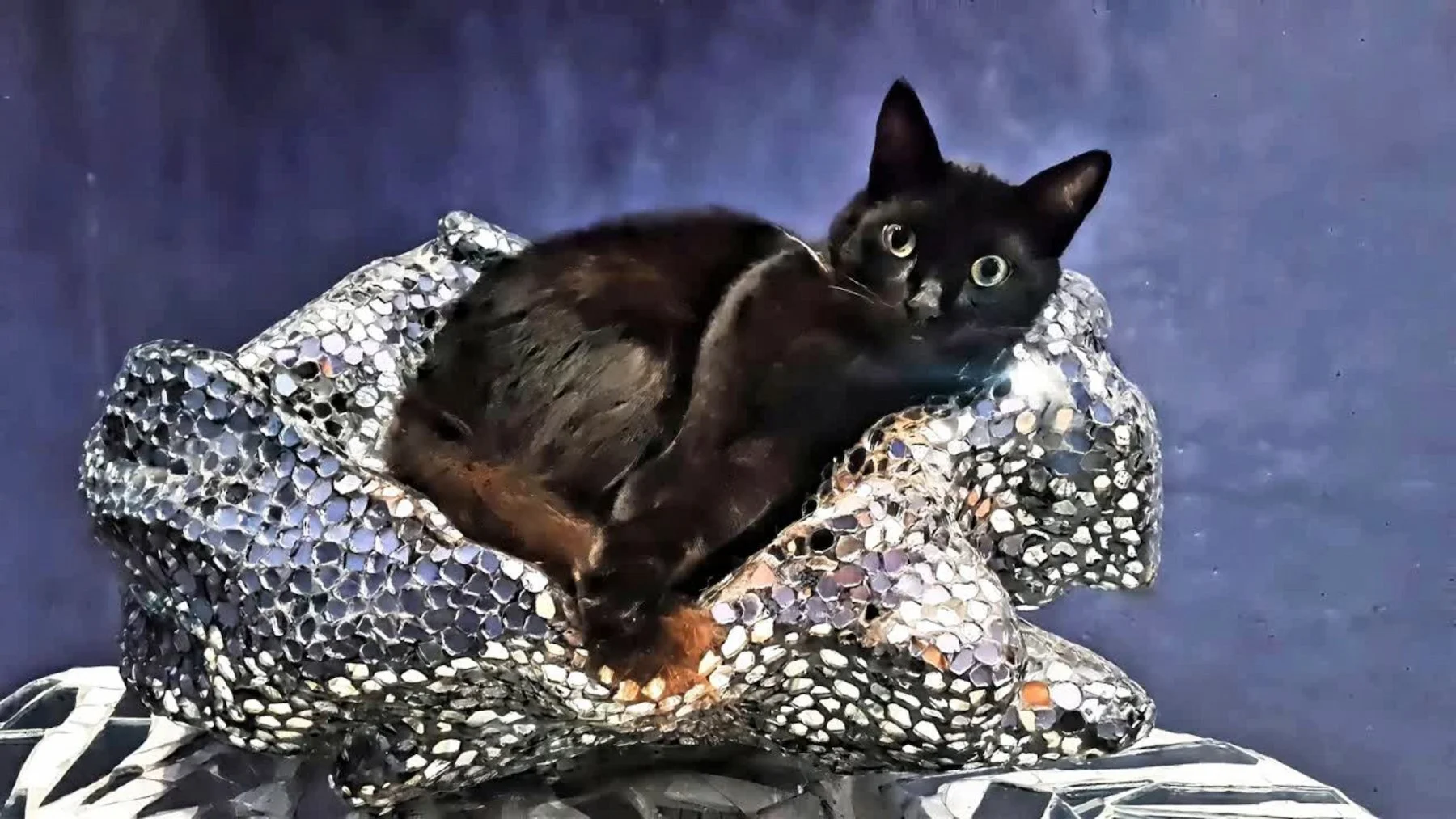
A cat is a threshold reader.
3 AM is a signal.
3:07 AM.
Your cat is on your chest. Purring. Still. Watching.
You tell yourself it’s affection. A little midnight sweetness.
A cleaner possibility: it’s regulation.
Cats don’t do reassurance the way humans do. They do thresholds. They notice the shift before you narrate it. And when something in your body tips, they often move first.
Not magic. Not “vibes.” Pattern recognition plus a small, heavy body with excellent timing.
(If you’re having night panic, heart symptoms, fainting, or new sleep disturbances: treat that as medical, not aesthetic. Get checked.)
What’s Happening at 3 AM
When humans destabilize at night, it’s rarely dramatic on the surface. It’s quiet physiology:
breathing gets shallow
the chest tightens
the nervous system slips into threat mode
sleep becomes “awake-but-not-awake”
Your cat doesn’t need your story. It reads the pre-story.
And it uses the simplest intervention it has: proximity, warmth, pressure, vibration.
Researchers often report cat purrs in a low-frequency band (commonly cited around 25–50 Hz). Some authors propose that low-frequency vibration could plausibly contribute to soothing or repair-related effects, but the evidence isn’t clinical-grade and is often repeated more confidently than it’s proven. Treat this as an interesting hypothesis, not a health claim.
Here’s the practical point: the pattern is observable even when the mechanism is debated. The cat appears. The body settles. The episode passes faster.
The Part People Miss: It’s Not Only Comfort. It’s Training.
Over time, many owners notice a sequence:
The cat intervenes before you’re consciously aware.
You start noticing the cat’s pattern (“she always comes right before I crash”).
You begin detecting your own signals earlier (tight jaw, shallow breath, chest compression).
The cat becomes less “urgent,” more companion.
That’s the real story: not “my cat loves me,” but “my cat keeps forcing me to become literate in my own thresholds.”
Dry addendum: cats are excellent teachers because they do not care if you agree with the lesson.
A Vedic Lens, Without the Fog
In Jyotiṣa (Vedic astrology), some practitioners use Ketu as a symbol for completion, detachment, perception training, and the reduction of noise. In that reading, cats correlate with “perception lessons” because they are specialists in noticing what’s subtle, shifting, or denied.
Important boundary: this is a symbolic model, not a medical claim and not a proven causal mechanism.
How to use it responsibly:
Track timing (when the cat arrived, when patterns intensified, when they softened).
Track domain (sleep, anxiety, home atmosphere, relationship stress).
Track progress (does the cat intervene less as you get better at noticing earlier?).
Not prediction. Pattern auditing.
What Ancient Cultures Noticed (And What We Turned Into Decor)
The cat wasn’t always framed as a cute accessory with good lighting.
Ancient Egypt treated cats as consequential. They were mummified at scale, tied to Bastet worship, with dedicated cat cemeteries.
Diodorus Siculus reports that killing a cat could trigger a lynching, even when officials tried to intervene.
And by the late 19th century, the reverence flipped into industry: in 1890, a shipment of mummified cats reportedly reached Liverpool and was crushed for fertiliser. It’s a brutal sentence, but a clarifying one.
Same animal. Same capacity to alter a room. Different century. Different story we tell ourselves.
The Nervous System Lens
Your cat is a biofeedback device with whiskers.
It responds to breathing changes, muscle tension, restlessness, micro-movements. You can test this by tracking: cat arrival time → your body state → resolution time.
The Home Ecology Lens
Cats are also environmental auditors.
They notice air quality shifts, noise, vibration, temperature gradients, and “something’s off” in a room before you do. If the 3 AM visits cluster after certain days (travel, arguments, new cleaning products, renovation, incense, moldy corners), your cat may be responding to the house as much as to you.
Nightwatch logic
Animals do the night shift for free.
When you sleep, you stop managing your face, your voice, your performance. Your body tells the truth. Cats are built to patrol thresholds: sleep/wake, calm/threat, safety/noise.
If your cat consistently appears at the same night window, treat it like a farm signal:
Something is repeatedly peaking there.
Not supernatural.
Just consistent.
Care ethics
Attention is love, not sentiment.
A cat’s care doesn’t look like devotion. It looks like precision. It shows up when your system is off, not when you want validation. That can feel cold until you realize it’s more reliable than reassurance.
Your cat doesn’t need you to understand.
It needs you to notice.
The 3 AM Cat Protocol (4 steps)
No mysticism. No drama. A field method.
Don’t interpret. Observe. (60 seconds)
Where is the cat sitting: chest, lap, neck, doorway, one specific room?Check three body cues. (30 seconds)
Breath: shallow or low?
Jaw: clenched or soft?
Temperature: hot hands, cold feet, sweating, chills?Regulate before you narrate. (2 minutes)
Choose one:
• slow exhale (longer exhale than inhale)
• hand on chest + belly, feel the rise, no analysisLog one line. (10 seconds)
“Cat arrived at ____. I felt ____.”
Do this for 7 nights. You’ll have data, not mythology.
When does your cat intervene (time + context)?
What’s the repeat cue (where it sits)?
What tends to happen after (calm, tears, insomnia, spiral)?
If you can answer those, you’re already doing the work:
moving from “cute” to “legible.”
What progress looks like (without turning it into a prophecy)
In this lens, you’re not trying to stop the cat. You’re trying to become perceptive enough that the cat doesn’t need to escalate.
You’ll often see a soft progression:
At first: frequent intervention, intense proximity
Then: earlier awareness on your side (“I felt it before the cat moved”)
Later: calmer presence, less corrective behavior
Eventually: the bond shifts from “sentinel” to “companion”
In practice: the cat doesn’t become less loving.
You become less avoidant.
Cats often operate as threshold readers.
They cue you toward perception, not comfort.
And yes, it’s slightly inconvenient. That’s why it works.
Closing
Your cat doesn’t need “love” to show up at 3 AM.
And that’s the point.
Love is an emotion. Beautiful, yes. Also variable, contextual, negotiated.
Regulation is a function. Quiet. consistent. It doesn’t require your consent or your understanding.
If you use the Vedic lens: think architecture, not romance.
Ketu marks a phase of completion and perception training. The cat often enters the story when that window opens, and leaves or softens when the work is done.
So you track three things:
Timing: when the cat arrived, what phase you were in (Daśā / transits)
Domain: which life-area the “perception debt” keeps repeating (house themes)
Progress: does the intervention pattern lessen as your own awareness strengthens?
That last one is the tell. When the cat stops having to “tap the glass,” it’s usually because you finally saw what was there.
Ancient cultures treated cats less like pets and more like instruments:
Egypt protected them with an intensity that reads extreme today.
Vedic traditions cast them as threshold specialists.
Persian medicine treated them as heart-and-sleep soothers.
We turned them into content. They kept doing the job.
So the question isn’t: “Does my cat love me?”
The question is: “What does my cat keep noticing that I keep refusing to notice?”
Not mysticism. Not sentimentality.
A purring form of feedback.
If you can read it with restraint, the bond becomes even more valuable than comfort:
Your cat isn’t only soothing you.
It’s teaching you to detect the signal earlier, without help.
Quietly. Repeatedly.
Until you don’t need the 3 AM intervention anymore.
If you want the bond mapped with precision, PACT reads three coordinates:
Entry: when your cat entered the story
Domain: where the perception debt sits
Signal: how the behavior tracks resolution over time
Not a reading. A diagnostic.
